
Every home tells a story about energy use, and energy guide ratings translate that story into numbers you can understand and act on. Canadian homeowners face rising utility costs and increasing pressure to reduce their carbon footprint, making these ratings more relevant than ever.
The EnerGuide rating system measures your home’s energy performance on a scale where zero represents maximum efficiency and higher numbers indicate greater consumption. Think of it as a report card for your house. A typical Canadian home built before energy codes existed might score 350 GJ/year or higher, while modern net-zero homes approach the zero mark. The difference between these extremes can mean thousands of dollars annually in heating, cooling, and electricity costs.
This rating isn’t just another bureaucratic number. It determines your eligibility for government rebates, influences resale value, and provides a roadmap for meaningful improvements. More importantly, it shows exactly where your home loses energy and money, whether through inadequate insulation, drafty windows, or inefficient heating systems.
Understanding your rating creates opportunities. Solar panels, better insulation, upgraded HVAC systems, and improved air sealing all shift your number downward. Each reduction represents real savings and environmental benefits. For Canadian homeowners serious about sustainability and cost reduction, the EnerGuide rating transforms abstract energy concerns into concrete targets. You’ll know where you stand, what improvements matter most, and how much impact each upgrade delivers.
What Are Energy Guide Ratings?
Energy guide ratings are standardized measurement tools that assign a numerical score to your home based on its energy consumption and efficiency. Think of them as report cards for buildings. They quantify how much energy your house needs to maintain comfortable living conditions throughout the year, taking into account heating, cooling, hot water, ventilation, and lighting.
Canada introduced its first residential energy rating system in the 1980s, responding to energy crises that made efficiency a national priority. What began as a modest labeling program evolved into today’s sophisticated EnerGuide system, an official Government of Canada mark that now provides detailed performance data for homes across the country. The program has expanded significantly, particularly as climate commitments have made reducing household emissions a key policy goal.
The purpose goes beyond simple number crunching. These ratings create a common language for discussing home performance. When you know your home scores 65 out of 100, you have an objective baseline for improvement and a way to compare your energy use against similar houses in your region. This standardization also helps real estate markets properly value efficiency upgrades and supports rebate programs by verifying actual performance gains.
It’s important to distinguish energy guide ratings from energy audits, though the terms sometimes blur. An audit is the process, the physical inspection, testing, and analysis conducted by a certified professional. The rating is the outcome, the score and detailed report you receive afterward. Some homeowners use “audit” and “rating” interchangeably, but technically the audit is what produces your rating.
The science relies on building physics. Evaluators measure physical characteristics like insulation thickness, window specifications, and air leakage rates. This data feeds into specialized computer models that simulate your home’s energy performance under standardized conditions. The models account for your local climate, your home’s orientation to the sun, and how all building components work together. What emerges is a precise calculation of annual energy consumption measured in gigajoules, then converted into that final rating score.
Understanding the EnerGuide Rating Scale
The 0-100 EnerGuide rating system provides Canadian homeowners with a clear, standardized way to understand their home’s energy performance. Unlike percentage-based scores where higher is better, the EnerGuide scale works inversely: a rating of 0 represents a home consuming maximum energy with no efficiency measures, while 100 indicates a completely energy self-sufficient home that produces as much energy as it consumes over a year.
Most Canadian homes fall somewhere in the middle of this spectrum. The average existing home built before modern energy codes typically scores between 55 and 65, reflecting standard construction practices and aging systems. Newly built homes constructed to current codes generally achieve ratings in the 70-80 range, while net-zero ready homes approach or exceed 90.
Your specific score tells you how your home compares to these benchmarks and reveals your potential for improvement. A rating increase of just 10 points can translate to meaningful reductions in heating and cooling costs, particularly in Canada’s climate where space heating accounts for over 60% of residential energy use.
| Rating Range | Performance Level | Typical Characteristics | Est. Annual Energy Cost |
|---|---|---|---|
| 0-50 | Poor Efficiency | Minimal insulation, old windows, inefficient furnace, significant air leakage | $3,500, $5,000+ |
| 51-65 | Below Average | Basic insulation, older HVAC systems, some upgrades needed | $2,500, $3,500 |
| 66-79 | Average to Good | Code-compliant construction, modern windows, efficient heating system | $1,800, $2,500 |
| 80-89 | High Performance | Advanced insulation, heat recovery ventilation, triple-pane windows | $1,200, $1,800 |
| 90-100 | Net-Zero Ready/Achieved | Superior envelope, renewable energy systems (solar panels), minimal energy demand | $500, $1,200 |
The rating accounts for your home’s physical characteristics and installed systems, but it’s calculated based on standardized assumptions about occupancy and thermostat settings. This means two identical homes will receive the same rating regardless of whether the occupants keep the temperature at 18°C or 23°C. The score reflects the building’s inherent efficiency, not your personal energy habits.
Understanding where your home sits on this scale helps you set realistic improvement goals and prioritize upgrades that will move you toward a more efficient, comfortable living space.
How EnerGuide Home Evaluations Work

What Gets Measured
During an EnerGuide evaluation, certified energy advisors examine virtually every component that affects how your home consumes and retains energy. The assessment creates a comprehensive picture of your home’s thermal performance, covering both the building envelope and mechanical systems.
The evaluation captures data across multiple categories:
- Insulation levels in attics, walls, basements, and crawl spaces
- Air leakage through cracks, gaps, and penetrations in the building envelope
- Heating and cooling equipment efficiency, age, and fuel type
- Ventilation systems including HRVs, ERVs, and exhaust fans
- Windows and doors, noting their age, type, and energy performance ratings
- Hot water systems and their efficiency specifications
- Renewable energy installations like solar panels or solar thermal systems
- Thermostats and programmable controls
- Foundation type and basement conditioning
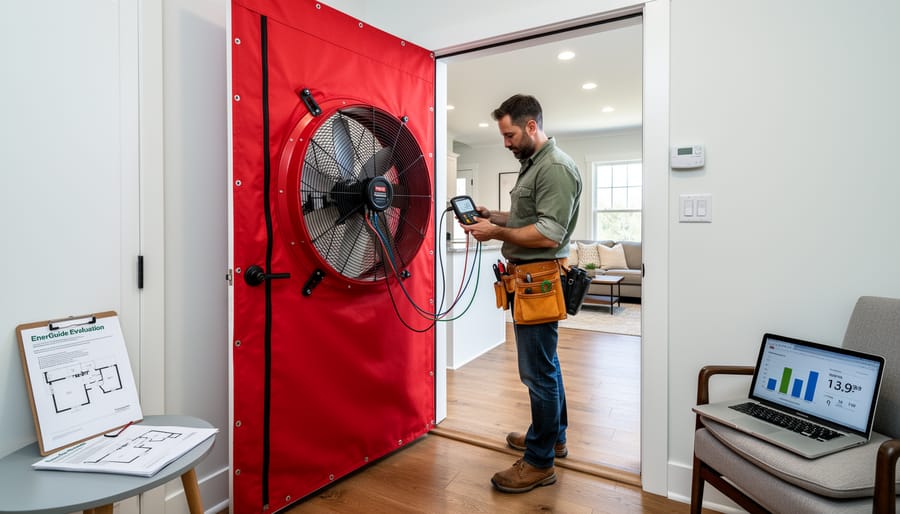
Advisors also record your home’s physical characteristics such as total floor area, ceiling heights, and orientation. This geometric data feeds into the HOT2000 software that calculates your final rating. The blower door test quantifies exactly how much air escapes through unsealed areas, measured in air changes per hour at 50 pascals of pressure.
What makes this process valuable is its objectivity. Two homes that look similar can receive vastly different ratings based on hidden factors like wall insulation quality or furnace efficiency. The evaluation reveals these invisible performance gaps, giving you a clear baseline for improvements.
The Technology Behind the Testing
The accuracy of your home’s EnerGuide rating depends on sophisticated diagnostic equipment that measures energy performance in ways human inspection alone can’t achieve. Your energy advisor uses tests and tools specifically designed to quantify how energy moves through your house.
The blower door test stands as the cornerstone of this evaluation. A powerful fan temporarily seals into an exterior doorway, depressurizing your home while instruments measure exactly how much air leaks through cracks, gaps and penetrations in your building envelope. The result, expressed as air changes per hour at 50 pascals of pressure (ACH50), reveals whether you have a tight, efficient home or one that’s essentially hemorrhaging heated air. Modern Canadian homes should aim for 2.5 ACH50 or less, while older houses often measure 8 or higher.
Thermal imaging cameras complement this by making the invisible visible. These tools detect temperature differences across walls, ceilings and windows, highlighting where insulation is missing or compressed and where cold air infiltrates. An advisor can spot thermal bridges, those sneaky pathways where heat escapes through structural elements, and identify moisture problems before they become serious.
All this raw data feeds into HOT2000 software, Natural Resources Canada’s official modeling program. This sophisticated tool simulates your home’s energy consumption throughout a full year, accounting for your local climate, house orientation, and every building component measured during the evaluation. The software crunches these variables to generate your final EnerGuide score and detailed recommendations for improvements.
Improving Your Home’s Energy Guide Rating
Solar Energy’s Impact on Your Rating
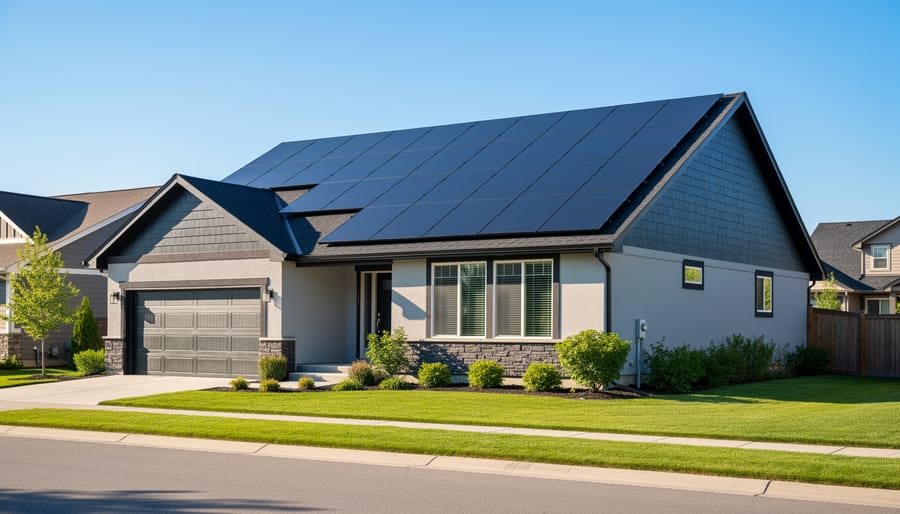
Solar panels deliver one of the most dramatic improvements to your home’s EnerGuide score. When you generate renewable electricity on-site, you directly reduce your home’s energy consumption from the grid, the primary factor the rating system measures.
The calculation treats solar generation as a credit against your home’s total energy use. If your solar array produces 8,000 kWh annually and your home consumes 12,000 kWh, your net energy consumption drops to 4,000 kWh. This reduction can boost your rating by 15 to 30 points, depending on your system size and your home’s baseline efficiency.
A typical Canadian home with an EnerGuide score of 65 might jump to 80 or higher after installing a 6-kilowatt solar system paired with modest efficiency upgrades. Some homeowners push past 90, approaching net-zero status where annual solar production nearly matches total consumption. These higher scores reflect homes that rely minimally on external energy sources throughout the year.
The rating methodology accounts for your location’s solar potential and seasonal variations. A system in southern Ontario will affect your score differently than an identical installation in northern British Columbia, reflecting regional differences in solar irradiance. Energy advisors use modeling software that factors in your roof orientation, shading, and panel specifications to calculate the realistic annual contribution.
Reaching net-zero, a rating of 100, requires both aggressive efficiency measures and substantial solar capacity. Most Canadian homeowners achieve this by combining high-performance insulation, air sealing, efficient heat pumps, and solar arrays sized to offset their remaining energy needs. The journey starts with understanding where your current rating stands and identifying which combination of improvements delivers the strongest impact.
Financial Benefits and Incentives
Your EnerGuide rating unlocks substantial financial benefits beyond lower utility bills. The federal Canada Greener Homes Grant provides up to $5,000 for energy-efficient retrofits, but you must complete an EnerGuide evaluation to qualify. The higher your post-retrofit rating improvement, the more rebate money you receive. Homeowners who achieve significant rating increases can access an additional $5,000 through the Oil to Heat Pump Affordability Grant if they switch heating systems.
Provincial programs stack on top of federal incentives. British Columbia’s CleanBC Better Homes program offers up to $6,000 for heat pumps and insulation upgrades based on EnerGuide assessments. Ontario’s Enbridge Home Efficiency Rebate provides rebates ranging from $250 to $5,000 for improvements documented through energy guide ratings. Quebec’s Rénoclimat program delivers grants up to $16,350 for homes that demonstrate rating improvements. These programs require certified EnerGuide evaluations to verify your home’s baseline performance and post-upgrade results.
Higher energy guide ratings directly impact your property value. Canadian real estate data shows homes with strong EnerGuide scores sell for 3-5% more than comparable properties without ratings. Buyers increasingly prioritize energy efficiency, viewing a good rating as proof of lower operating costs and modern building standards. Your rating becomes a competitive advantage in housing markets where energy concerns influence purchasing decisions.
Insurance companies in several provinces now offer premium discounts for homes with favorable energy guide ratings. These discounts typically range from 5-15% annually because efficient homes face lower risks of freeze damage, moisture problems, and heating system failures. The cumulative savings over a decade can exceed $3,000 for an average household.
Long-term energy savings remain the most significant financial benefit. Improving your rating from 55 to 75 typically reduces annual heating and cooling costs by $800-1,200. Homes approaching net-zero ratings with solar integration can eliminate utility bills entirely, saving $2,000-3,000 yearly. Over a 25-year mortgage period, these savings compound to represent tens of thousands of dollars in household budget relief.
Common Questions About Energy Guide Ratings
How long does an EnerGuide rating remain valid?
An EnerGuide rating doesn’t expire, but it represents your home’s energy performance at the time of evaluation. Most homeowners get a new evaluation after completing major energy retrofits or when selling their home to reflect current efficiency levels.
Are EnerGuide evaluations mandatory for homeowners?
No, EnerGuide evaluations are completely voluntary for existing homes. However, you’ll need both pre- and post-retrofit evaluations to qualify for federal programs like the Canada Greener Homes Grant.
Will a higher rating increase my home’s resale value?
Yes, homes with strong EnerGuide ratings typically command higher prices and sell faster. Buyers recognize that better ratings mean lower utility costs and more comfortable living conditions, making energy-efficient homes more attractive investments.
What’s the difference between pre- and post-retrofit evaluations?
A pre-retrofit evaluation establishes your baseline rating and provides recommendations for improvements. The post-retrofit evaluation measures your home’s performance after upgrades, documents your rating improvement, and validates your eligibility for rebate payments.
Beyond these common questions, homeowners often wonder whether their rating appears on public records. Your EnerGuide score remains private unless you choose to share it, such as including it in real estate listings to highlight your home’s efficiency. Some sellers display their EnerGuide label prominently during showings as a selling feature.
The timing between evaluations matters too. Most rebate programs require you to complete your post-retrofit assessment within 12 to 18 months of the initial evaluation. This window ensures your improvements happen while your baseline data remains relevant and prevents gaming the system through normal equipment aging.
If you’re planning multiple upgrades over several years, you can get intermediate evaluations to track progress, though these won’t unlock additional rebates. Many homeowners find value in seeing how each major improvement shifts their score, particularly when adding solar panels or replacing heating systems.
Understanding your home’s energy guide rating isn’t just about receiving a number on a report. It’s about gaining clear insight into where your home stands today and what specific steps will make the biggest difference in reducing your energy consumption and environmental impact. Your EnerGuide score gives you a roadmap, showing exactly which upgrades will deliver real results rather than leaving you guessing about where to invest.
For Canadian homeowners, pursuing an EnerGuide evaluation represents a practical first step toward creating a more efficient, comfortable living space. The knowledge you gain reveals opportunities you might never have considered, from air sealing that eliminates drafts to solar installations that can dramatically boost your rating while cutting utility bills. These aren’t abstract concepts. They’re tangible improvements that pay dividends month after month.
Beyond personal benefits, every home that improves its energy performance contributes to Canada’s broader transition toward cleaner residential energy. As more homeowners understand and act on their ratings, we’re collectively reducing our carbon footprint and building a more sustainable future. The combination of accessible evaluation services, generous rebate programs, and proven retrofit solutions means there’s never been a better time to discover what your home’s energy guide rating reveals and take action to improve it.