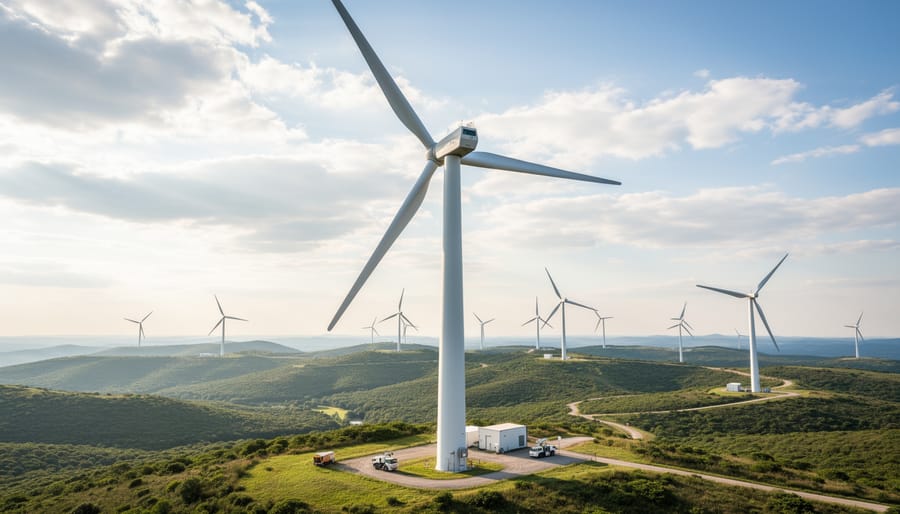
Wind turbines transform the kinetic energy of moving air into clean electricity through an elegant process that powers millions of homes worldwide. When wind strikes a turbine’s massive blades—some stretching over 100 meters in length—it creates lift similar to an airplane wing, causing them to rotate around a central hub. This rotation drives a shaft connected to a generator housed in the turbine’s nacelle, where magnets spinning past copper coils produce an electrical current through electromagnetic induction. The generated electricity flows down the tower through cables, passes through a transformer to increase voltage for efficient transmission, and feeds into the power grid that delivers energy to communities.
The physics behind this process are remarkably straightforward: wind speed determines power output, with generation capacity increasing exponentially as winds strengthen. A turbine at 15 miles per hour produces eight times more electricity than at 7.5 miles per hour, making strategic placement in consistently windy locations essential. Modern turbines operate most efficiently at wind speeds between 25 and 55 miles per hour, automatically adjusting blade pitch to optimize performance while protecting equipment during storms. This renewable energy source produces zero emissions during operation, making it a cornerstone technology in the global transition toward sustainable power generation.
The Basic Science Behind Wind Energy
Wind energy begins with a simple yet powerful natural phenomenon: the uneven heating of Earth’s surface by the sun. As sunlight strikes our planet, different surfaces absorb heat at varying rates. Land masses warm up more quickly than water bodies, forests retain heat differently than deserts, and urban areas create distinct temperature zones compared to rural landscapes. This differential heating creates pressure variations in our atmosphere, and nature seeks balance by moving air from high-pressure areas to low-pressure regions. This movement of air is what we experience as wind.
The key to understanding wind power lies in recognizing that moving air carries kinetic energy—the energy of motion. When air molecules travel at speed, they possess significant energy potential, much like a moving vehicle or flowing water. The amount of energy available in wind increases dramatically with velocity; in fact, the power available grows with the cube of wind speed. This means that if wind speed doubles, the available energy increases eightfold, making even modest increases in wind velocity highly valuable for energy generation.
Wind represents an exceptional renewable resource for several compelling reasons. Unlike fossil fuels, wind will continue to exist as long as the sun shines and Earth’s atmosphere remains in motion. It produces zero emissions during operation, requires no water for cooling, and leaves no waste products behind. The resource is abundant across many regions globally, from coastal areas to prairie landscapes to mountainous terrain.
Understanding this foundation helps us appreciate why wind energy has become a cornerstone of the clean energy transition. By harnessing the kinetic energy already present in our atmosphere, we can generate electricity without depleting natural resources or contributing to climate change, making wind power an increasingly vital component of sustainable energy systems.
The Anatomy of a Wind Turbine
Rotor Blades: Capturing the Wind
The rotor blades are the turbine’s primary energy-capturing component, engineered with sophisticated aerodynamic principles similar to airplane wings. Modern blades typically span 50 to 80 meters in length, with offshore turbines featuring even longer designs to maximize energy capture. When wind flows over the curved blade surface, it creates different air pressures on each side, generating lift that causes rotation—transforming kinetic energy from moving air into mechanical motion.
Blade design balances multiple factors to achieve optimal efficiency. Manufacturers construct blades primarily from lightweight yet durable composite materials like fiberglass and carbon fiber, which withstand extreme weather while maintaining flexibility. The blade’s distinctive twist and taper, carefully calculated through advanced computer modeling, ensures consistent performance across varying wind speeds.
Three-blade configurations dominate the industry because they provide the ideal balance between efficiency, stability, and cost-effectiveness. Modern turbines can capture approximately 45-50% of available wind energy, approaching the theoretical maximum known as the Betz limit. This impressive efficiency, combined with ongoing innovations in blade technology, makes wind power increasingly competitive with traditional energy sources. As materials science advances, next-generation blades promise even greater performance, helping communities worldwide transition toward cleaner energy futures.
The Nacelle: Where the Magic Happens
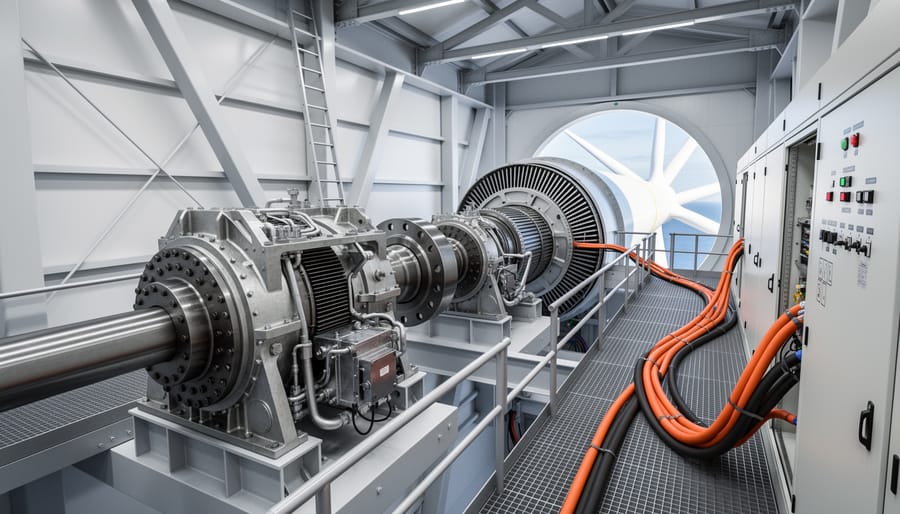
The nacelle sits atop the turbine tower and houses the critical components that transform wind’s kinetic energy into usable electricity. Think of it as the turbine’s engine room, where the real conversion magic occurs.
Inside, the low-speed shaft connects directly to the rotor, spinning at approximately 30-60 rotations per minute. This rotation enters the gearbox, a sophisticated system of gears that increases the rotational speed dramatically—often by a factor of 100. This acceleration is essential because generators require high-speed rotation to produce electricity efficiently.
The high-speed shaft then drives the generator, which uses electromagnetic induction to convert mechanical rotation into electrical current. As magnets spin past coils of copper wire, they create an electrical flow—the same fundamental principle discovered nearly two centuries ago, now scaled for clean energy production.
Additional components within the nacelle include a controller that monitors wind conditions and optimizes turbine performance, along with a yaw drive that rotates the entire nacelle to keep the rotor facing into the wind. Cooling systems prevent overheating, while brake systems provide safety during extreme weather or maintenance periods. Together, these components work seamlessly to capture nature’s power and deliver renewable electricity to communities across Canada and beyond.
Tower and Foundation
The tower and foundation form the essential backbone of every wind turbine, elevating the blades to where wind resources are strongest and most reliable. Modern wind turbine towers typically stand between 80 to 120 meters tall—roughly the height of a 30-story building—though some offshore installations reach even greater heights. This elevation is crucial because wind speed increases significantly with altitude, away from ground-level obstacles like buildings, trees, and terrain features that create turbulence and slow wind movement.
The relationship between height and wind power is exponential. Even a modest increase in tower height can capture substantially faster winds, which translates directly to greater energy generation potential. At higher elevations, winds also blow more consistently, reducing the intermittency challenges that renewable energy systems sometimes face.
Supporting these massive structures requires robust foundations, typically constructed from hundreds of tons of reinforced concrete extending deep into the earth. These foundations must withstand tremendous forces—not just the weight of the turbine itself, but also the constant dynamic loads from rotating blades and powerful wind gusts. This supporting infrastructure represents a significant engineering achievement, ensuring safe and reliable operation for the turbine’s 20-25 year lifespan while maximizing access to clean, renewable wind energy.
The Step-by-Step Generation Process
Understanding how wind transforms into usable electricity is a fascinating journey that demonstrates the elegance of renewable energy technology. Let’s walk through each stage of this conversion process, from the moment wind reaches a turbine to when electricity flows into your home.
The process begins when moving air encounters the turbine’s massive blades. Wind represents kinetic energy—the energy of motion—created by uneven heating of Earth’s surface by the sun. When this moving air strikes the carefully engineered blades, it transfers its kinetic energy to them, causing rotation. The blade design is crucial here; their aerodynamic shape, similar to airplane wings, maximizes the capture of wind energy while allowing the rotor to spin efficiently even in moderate wind conditions.
As the blades rotate, they turn a central shaft called the low-speed shaft, which typically spins at 30 to 60 revolutions per minute. However, most generators require much faster rotation to produce electricity efficiently. This is where the gearbox enters the picture. Located inside the turbine’s nacelle—the housing unit sitting atop the tower—the gearbox increases the rotational speed dramatically, typically by a factor of 100. The high-speed shaft emerging from the gearbox can spin at approximately 1,000 to 1,800 revolutions per minute.
This high-speed rotation drives the generator, the component responsible for the actual electricity production. Inside the generator, the rotating shaft spins powerful magnets past coils of copper wire. This motion creates a changing magnetic field that induces an electrical current in the wires—a principle called electromagnetic induction discovered by Michael Faraday in the 1830s. Essentially, mechanical energy has now been converted into electrical energy.
The electricity produced initially comes out as alternating current, but it may not match the voltage and frequency standards of the power grid. A transformer, either located within the turbine or at a nearby substation, adjusts the electricity to the appropriate voltage level. In Canada and most of North America, this means standardizing to 60 hertz frequency and appropriate transmission voltages.
Finally, the conditioned electricity travels through underground or overhead cables to a substation, where it connects to the broader electrical grid. From there, it flows alongside electricity from other sources—whether renewable like solar or traditional sources—distributing to homes, businesses, and industries. The entire process, from wind striking the blades to power reaching consumers, happens continuously and seamlessly, providing clean energy without emissions or fuel consumption.
Onshore vs. Offshore Wind Generation
Wind power installations fall into two primary categories, each offering distinct advantages for renewable energy generation. Understanding these differences helps illuminate how countries like Canada are strategically developing their wind energy capacity.
Onshore wind farms are constructed on land and represent the most common and cost-effective form of wind energy generation. These installations benefit from easier accessibility for construction, maintenance, and grid connection. The infrastructure costs are significantly lower since technicians can drive directly to turbine sites, and connecting to existing electrical grids is relatively straightforward. Onshore wind has become increasingly affordable, with technological improvements making it one of the most economical energy sources available today. However, onshore installations face limitations including local opposition due to visual impact and noise concerns, along with land-use constraints in densely populated areas.
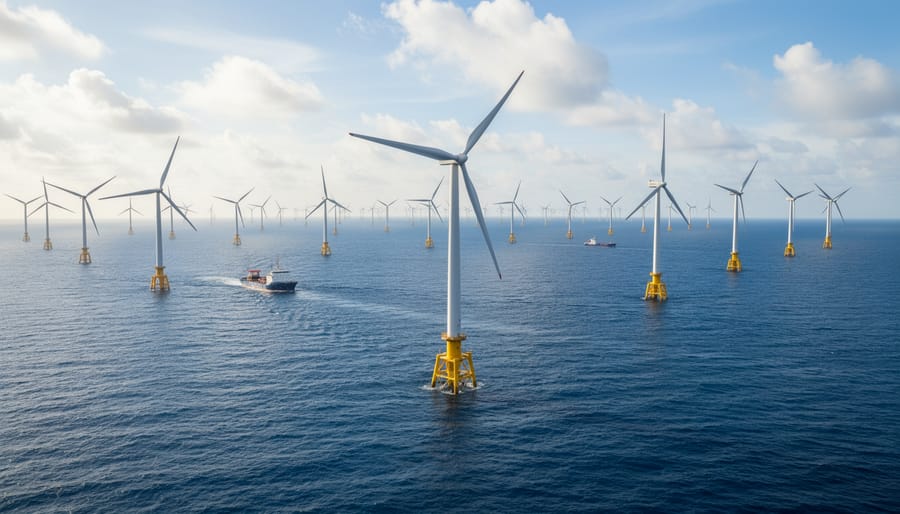
Offshore wind farms, positioned in bodies of water, tap into stronger and more consistent wind resources. Ocean and lake environments typically experience steadier, more powerful winds without the disruption caused by terrain features like hills or buildings. This consistency translates to higher capacity factors and greater energy output per turbine. Offshore installations also avoid many land-use conflicts and can accommodate larger turbines that would be impractical on land. The challenges include substantially higher construction and maintenance costs, more complex installation procedures requiring specialized vessels, and greater exposure to harsh marine conditions that can accelerate equipment wear.
Canada’s renewable energy strategy currently emphasizes onshore wind development, with provinces like Ontario, Quebec, and Alberta leading in installed capacity. The country’s vast landmass provides abundant suitable locations for onshore farms. However, offshore potential is gaining attention, particularly along coastal provinces. As technology advances and costs decrease, offshore wind presents exciting opportunities for Canada’s maritime regions to contribute to the nation’s clean energy transition. Both approaches play complementary roles in building a diverse, resilient renewable energy portfolio that moves us closer to a sustainable future.
How Much Power Can Wind Actually Generate?
Understanding the actual power generation potential of wind turbines helps put this renewable energy source into perspective. A typical modern wind turbine can generate between 2 to 3 megawatts (MW) of electricity, though larger offshore models can produce 12 MW or more. However, it’s important to note that turbines don’t run at maximum capacity all the time.
The capacity factor measures how often a turbine generates power compared to its maximum potential. In Canada, onshore wind farms typically achieve capacity factors between 30% and 40%, meaning they produce that percentage of their maximum possible output over a year. This variation occurs because wind doesn’t blow consistently at optimal speeds. Offshore installations often perform better, reaching capacity factors of 40% to 50% due to stronger, more consistent ocean winds.
To put this in practical terms, a single 2.5 MW turbine operating at a 35% capacity factor can power approximately 400 to 500 Canadian homes annually. The exact number depends on local energy consumption patterns and seasonal variations. Canada’s Granville Wind Farm in Ontario, for instance, uses 38 turbines to generate enough electricity for about 15,000 homes.
Regional differences also matter significantly. Coastal provinces like Newfoundland and Labrador, along with parts of Quebec and Alberta, experience stronger average wind speeds, resulting in higher capacity factors and more efficient power generation. Prairie provinces benefit from consistent winds that make wind farms particularly productive.
These numbers demonstrate wind power’s substantial contribution to clean energy goals. As turbine technology continues advancing, we’re seeing improvements in both capacity and efficiency, making wind an increasingly viable solution for reducing carbon emissions while meeting growing energy demands across Canada.
Wind power generation stands as a remarkable example of how we can harness nature’s forces to create clean, sustainable energy for our communities. Through the elegant conversion of kinetic energy into electricity, wind turbines demonstrate that effective renewable solutions don’t have to be complicated—they simply need to work with natural systems rather than against them.
As Canada continues expanding its renewable energy portfolio, wind power plays an increasingly vital role alongside solar and hydroelectric generation. The technology has matured significantly, offering reliable, cost-effective electricity while reducing our carbon footprint and contributing to climate change mitigation. From the prairie provinces to coastal regions, wind farms are reshaping our energy landscape and proving that a transition to clean power is not only possible but practical.
Whether you’re a homeowner considering renewable energy options, an educator inspiring the next generation, or simply someone curious about sustainable solutions, understanding wind power generation empowers you to make informed decisions. Consider supporting wind energy initiatives in your community, exploring how clean energy can power your home or business, and advocating for continued investment in renewable infrastructure. Together, these individual actions contribute to a cleaner, more sustainable energy future for all Canadians.