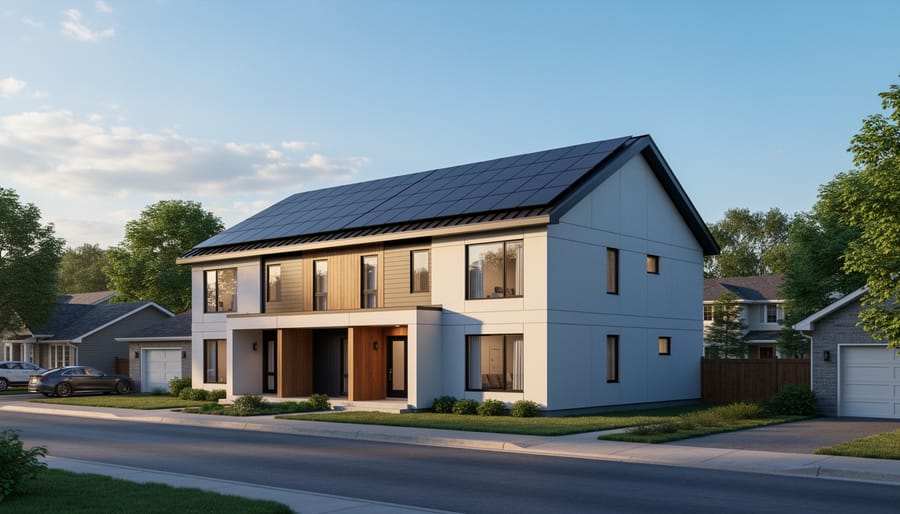
Wind energy stands as one of the most mature and rapidly expanding renewable energy sources available in 2026, converting the kinetic power of moving air into clean electricity through turbine technology. This renewable resource produces zero emissions during operation, costs nothing to fuel, and has become increasingly cost-competitive with fossil fuels, making it a cornerstone of the global energy transition alongside solar power.
Understanding how wind energy works and fits into the broader renewable energy landscape helps Canadians make informed decisions about their energy future. Wind turbines operate on a simple principle: blades capture moving air and spin a rotor connected to a generator that produces electricity. What makes wind particularly valuable is its complementary relationship with solar energy. Wind often blows strongest during evening hours and winter months when solar production drops, creating a natural balance in renewable energy systems.
Canada’s geography offers exceptional wind resources, particularly across the Prairies, along coastal regions, and in mountainous areas. The country has embraced both utility-scale wind farms that power thousands of homes and small-scale residential turbines that supplement household energy needs. For environmentally conscious Canadians exploring renewable options, wind energy presents proven technology with decades of real-world performance data.
The economics have shifted dramatically. Wind power now competes directly with traditional energy sources on price, while offering energy independence and protection from fuel price volatility. Whether considering community wind projects or exploring how wind complements rooftop solar installations, this renewable resource deserves serious attention from anyone committed to sustainable energy solutions.
What Is Wind Energy and How Does It Work?
Wind energy harnesses the natural movement of air across Earth’s surface to generate electricity. When the sun heats different parts of our planet unevenly, it creates temperature differences that cause air to move, producing wind. This constant, renewable resource powers turbines that transform moving air into clean electricity without burning fuel or producing emissions.
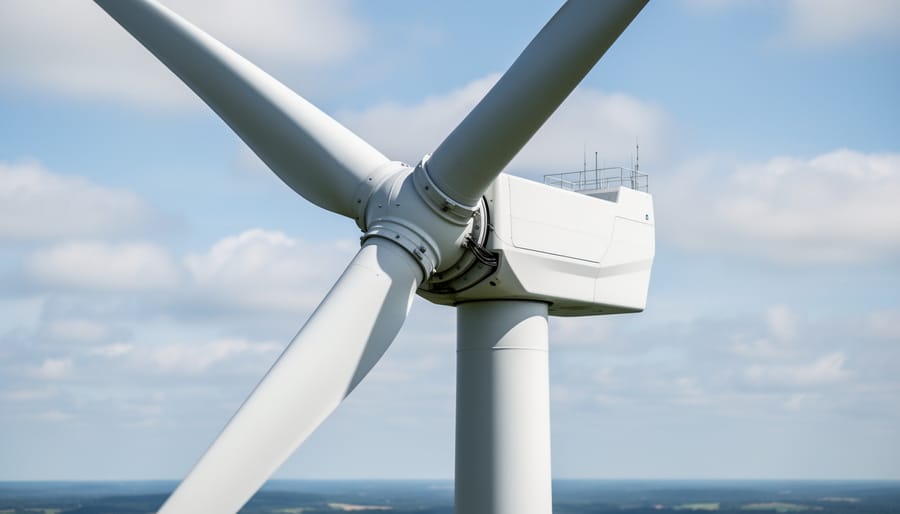
The process starts when wind strikes the blades of a turbine, causing them to spin. These massive blades, which can stretch over 50 meters long on utility-scale turbines, are shaped like airplane wings to maximize efficiency. As they rotate, they turn a shaft connected to a generator housed inside the turbine’s body. This wind generator converts energy from mechanical rotation into electrical current through electromagnetic induction, the same principle discovered by Michael Faraday in the 1830s.
Understanding a few key terms helps clarify how these systems work:
- Turbine
- The complete structure that captures wind and generates electricity, including the tower, blades, and internal machinery.
- Rotor
- The rotating assembly of blades that catches the wind and begins the energy conversion process.
- Nacelle
- The housing atop the tower that contains the gearbox, generator, and control systems, protecting them from weather.
- Generator
- The component that converts the spinning motion into usable electrical energy.
- Kinetic Energy
- The energy contained in moving air, which turbines capture and transform into electricity.
- Capacity Factor
- The percentage of time a turbine actually produces power compared to its maximum potential, typically 25-45% for wind systems.
Modern turbines feature sophisticated controls that adjust blade pitch and turbine direction to capture maximum energy while protecting the machinery. When wind speeds are too low (usually below 3-4 meters per second), turbines remain idle. When speeds exceed safe thresholds during storms, they shut down automatically. Between these extremes, turbines operate most efficiently at wind speeds of 12-17 meters per second.
The electricity generated flows through cables down the tower to transformers that adjust voltage for transmission through power grids. From there, it travels to homes, businesses, and industries just like electricity from any other source. What makes wind special is its clean generation process and the fact that the “fuel” constantly replenishes itself at no cost.
Types of Wind Energy Systems
Onshore Wind Farms
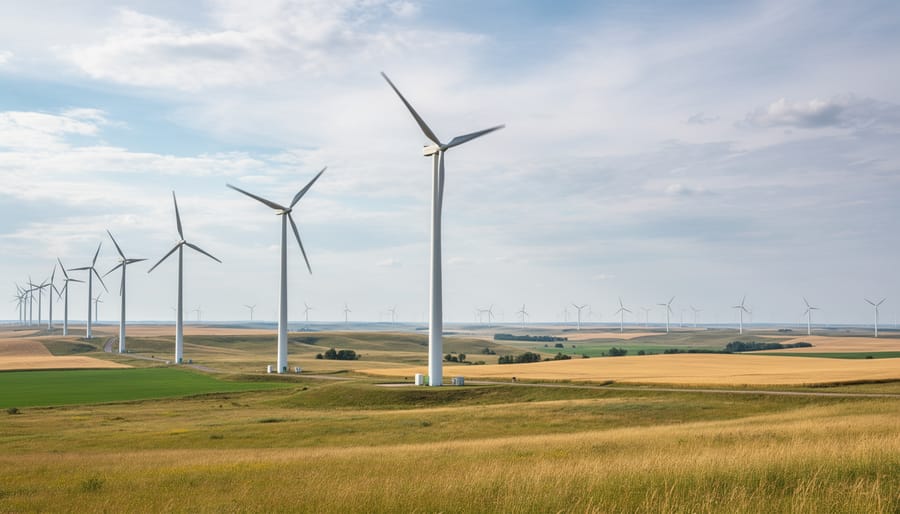
Onshore wind farms represent the most established and widely deployed form of wind energy across Canada. These land-based installations consist of multiple wind turbines strategically positioned in areas with consistent wind patterns, typically on open plains, coastal regions, or elevated terrain where air movement is strong and reliable.
The primary advantage of onshore wind farms lies in their proven scalability and cost-effectiveness for large-scale renewable energy generation. Installation and maintenance costs remain significantly lower than offshore alternatives, making onshore wind an economically attractive option for utilities and energy providers. Once operational, these farms produce electricity with zero emissions, directly contributing to Canada’s renewable energy targets while creating minimal environmental footprint.
Canada’s prairie provinces, particularly Alberta, Saskatchewan, and Manitoba, host substantial onshore wind capacity, leveraging expansive flatlands and steady wind currents. Ontario and Quebec also feature significant installations, often integrating wind power with other renewable energy sources to diversify their clean energy portfolios. Coastal regions in the Maritimes benefit from ocean-influenced wind patterns that enhance energy production consistency.
For communities and provinces pursuing clean energy transitions, onshore wind farms deliver reliable, renewable electricity at a scale that meaningfully offsets fossil fuel dependence. Their compatibility with agricultural land use allows farmers to lease property while continuing crop cultivation, creating dual revenue streams that strengthen rural economies across the country.
Offshore Wind Energy
Offshore wind energy systems are installed over oceans or large bodies of water, where turbines can capture stronger and more consistent winds than most land-based sites. Because water surfaces create less friction than terrain, offshore locations often deliver steadier, more predictable power generation, a significant advantage for renewable energy sources relying on wind. Turbines mounted on fixed foundations or floating platforms can access these reliable wind resources, making offshore installations highly productive.
Canada’s extensive coastlines along the Atlantic, Pacific, and Arctic oceans, plus vast Great Lakes shorelines, present considerable opportunities for offshore wind development. Offshore projects can generate substantial clean electricity without competing for land used by communities, agriculture, or conservation. They also tend to produce power during peak demand periods when coastal winds strengthen.
While Canada’s offshore wind sector remains in early stages compared to onshore projects, pilot initiatives and feasibility studies are exploring deployment along Nova Scotia’s coast and in other promising maritime regions. Offshore wind complements other renewable energy sources by tapping into a different resource zone. As technology advances and costs decline, offshore wind could become a major contributor to Canada’s clean energy mix, working alongside solar installations and onshore wind farms to meet climate goals and expand renewable power capacity across diverse geographic areas.
Small-Scale and Residential Wind Systems
Small wind turbines bring renewable energy directly to individual properties, offering an accessible entry point for homeowners, farmers, and rural communities seeking energy independence. These systems typically range from 400 watts to 100 kilowatts, with residential units averaging 5-15 kilowatts, enough to offset a significant portion of household electricity consumption. Unlike massive commercial installations, small-scale wind systems can fit on properties as modest as one acre, making wind power feasible for thousands of Canadians previously unable to participate.
Farms particularly benefit from small wind installations, as they often possess the necessary land, consistent wind exposure, and high energy demands for irrigation, livestock operations, and equipment. Remote communities across Northern Canada increasingly deploy these systems alongside solar panels, creating hybrid renewable energy solutions that provide reliable power where grid connection proves impractical or prohibitively expensive. A 10-kilowatt turbine can generate 10,000-16,000 kilowatt-hours annually in favorable Canadian wind conditions, roughly equivalent to the annual consumption of a typical household.
The upfront investment ranges from $15,000 to $75,000 depending on system size, though federal and provincial incentives often reduce these costs. For properties with average wind speeds above 4.5 meters per second, small wind systems deliver meaningful returns while reducing reliance on fossil fuel-based grid electricity.
Benefits of Wind as a Renewable Energy Source
Wind energy delivers compelling advantages that make it one of the most attractive renewable energy sources available today. As Canada accelerates its clean energy transition, understanding these benefits helps explain why wind power plays such a vital role alongside other renewables.
The environmental case for wind energy starts with its zero-emission operation. Once installed, wind turbines generate electricity without burning fuel or releasing greenhouse gases, air pollutants, or water contaminants. EPA life-cycle emissions data confirms that wind energy produces dramatically lower carbon emissions than fossil fuels across its entire lifespan, including manufacturing and installation. This clean generation directly reduces Canada’s carbon footprint and improves air quality in communities across the country.
Wind’s key advantages include:
- Emission-free electricity generation with no air or water pollution
- Inexhaustible resource that never depletes or runs out
- Minimal operating costs after initial installation
- Significant job creation in manufacturing, installation, and maintenance
- Dual land use allowing farming and ranching beneath turbines
- Natural complement to solar energy for round-the-clock renewable power
The economic benefits extend throughout Canadian communities. Wind projects create well-paying jobs in rural and remote areas, from turbine manufacturing to ongoing maintenance work. Landowners who host turbines earn steady lease income while continuing agricultural operations, since wind farms typically use less than 5% of the land footprint. This dual-use approach strengthens rural economies without removing productive farmland from service.
Wind energy also offers practical advantages that strengthen overall grid reliability. Wind often blows strongest during different times than peak solar generation, creating natural complementarity between these two renewable sources. Winter storms that reduce solar output frequently bring strong winds, while summer evenings may deliver wind power as solar production drops. This synergy allows renewable energy systems combining wind and solar to provide more consistent power than either source alone.
The resource itself is abundant and free. Unlike fossil fuels that require extraction, transportation, and purchasing, wind simply needs to be captured. Once turbines are installed, fuel costs drop to zero, insulating electricity rates from the price volatility that affects conventional energy sources. This stability benefits both utilities and consumers planning long-term energy budgets.
Wind Energy in Canada: Current State and Opportunities
Canada has emerged as a global leader in harnessing wind as a renewable energy source, with installed capacity exceeding 16,000 megawatts that powers millions of homes from coast to coast. This growth reflects the country’s serious commitment to diversifying its renewable energy portfolio beyond traditional hydropower while working toward ambitious climate targets.
Ontario, Quebec, and Alberta lead the charge in wind development, each taking distinct approaches suited to their regional landscapes. Ontario’s wind farms dot agricultural regions where turbines coexist with farming operations, generating clean electricity while landowners earn supplemental income. Quebec leverages its vast northern territories and strong seasonal winds, particularly in the Gaspésie region where towering turbines capture consistent airflow from the St. Lawrence River valley. Alberta’s prairies offer some of North America’s best wind resources, attracting major investments in utility-scale projects that complement the province’s energy transition efforts.
Notable installations demonstrate wind’s scalability across Canadian terrain. The Rivière-du-Moulin wind farm in Quebec generates enough power for 40,000 homes, while Ontario’s Niagara Region Wind Farm showcases how wind infrastructure integrates into settled areas without disrupting communities. These projects prove that wind energy sources work reliably in Canada’s challenging climate, from frigid prairie winters to coastal humidity.
Opportunities for expansion remain substantial, particularly in offshore wind along Atlantic coastlines and the Great Lakes. Federal targets aim for net-zero emissions by 2050, positioning wind alongside solar as complementary renewable energy sources that balance each other’s output patterns. Wind typically generates more electricity during winter and overnight hours, precisely when solar production drops, creating a natural partnership for grid stability.
Rural and remote communities see wind as an economic catalyst, bringing construction jobs, ongoing maintenance employment, and local tax revenue. Indigenous partnerships in wind development are expanding, ensuring communities benefit directly from renewable energy sources on their traditional territories. As costs continue falling and technology improves, wind’s role in Canada’s clean energy transformation will only accelerate.
Comparing Wind Energy to Other Renewable Energy Types
Wind energy doesn’t operate in isolation, it’s one pillar in a diverse renewable energy portfolio that includes solar, hydropower, and geothermal sources. Each renewable energy source brings distinct strengths, and understanding how they complement each other reveals the path toward reliable, clean power systems.
| Renewable Source | Best Conditions | Scalability | Complementary Strengths |
|---|---|---|---|
| Wind | Coastal areas, open plains, high-altitude sites with consistent airflow | Excellent for large-scale farms and distributed systems | Generates power at night and during cloudy periods when solar drops |
| Solar | Clear days, southern exposures, regions with high annual sunshine | Highly flexible from rooftop to utility-scale arrays | Peaks during midday when wind often slows; pairs well with wind’s evening production |
| Hydropower | Rivers with reliable flow, areas with elevation change | Large capacity but site-dependent | Provides on-demand baseload power to stabilize wind and solar variability |
| Geothermal | Volcanic regions, areas with accessible underground heat | Limited by geography but consistent where viable | Delivers constant output regardless of weather, balancing intermittent sources |
The wind-solar partnership deserves special attention for Canadian applications. Wind turbines often produce peak output during winter months and evening hours, precisely when solar generation weakens. A household or community combining rooftop solar panels with nearby wind capacity can achieve steadier electricity supply across seasons and throughout the day. This synergy reduces reliance on grid power or battery storage while maximizing clean energy use.
Canada’s geography offers abundant potential across all four renewable energy sources. British Columbia and Quebec leverage massive hydroelectric resources, the Prairies capture strong winds, Ontario and the Maritimes blend solar and wind installations, and geothermal opportunities exist in Alberta and parts of BC. Rather than competing, these renewable energy sources form an integrated network, wind filling gaps left by solar’s nighttime pause, hydro stabilizing the grid during calm periods, and geothermal providing steady baseline power where geology permits.
Common Questions About Wind Energy
How noisy are wind turbines?
Modern wind turbines produce a gentle whooshing sound, typically measuring 35-45 decibels at 300 meters, similar to a quiet library or rustling leaves. Advances in blade design and gearbox technology have dramatically reduced operational noise. Most Canadian wind farms maintain setback distances of 550 meters or more from homes, ensuring minimal disturbance. Residents near wind installations often report the sound becomes background noise they barely notice.
Do wind turbines harm birds and wildlife?
While early turbine designs posed challenges, today’s slower-rotating blades and careful site selection significantly reduce wildlife impacts. Studies show wind energy causes far fewer bird deaths than domestic cats, building collisions, or fossil fuel infrastructure. Canadian wind projects conduct environmental assessments before construction, avoiding migration corridors and sensitive habitats. Painted blades and radar-based shutdown systems further protect wildlife.
Is wind power reliable when the wind doesn’t blow?
Wind energy works best as part of a diverse renewable portfolio. When wind slows in one region, it often increases elsewhere across Canada’s vast geography. Battery storage systems and grid connections with complementary sources like solar and hydropower ensure consistent electricity supply. Weather forecasting allows grid operators to predict wind generation days in advance, enabling efficient energy management.
Can homeowners benefit from wind energy?
Absolutely. Small residential turbines suit rural properties with adequate wind resources and space. Community wind projects let homeowners invest in shared installations. Many Canadians also choose green energy plans from utilities, supporting wind development through their electricity bills without installing equipment.
Wind energy stands as one of the most promising renewable energy sources for Canada’s clean power future. As we’ve explored throughout this guide, wind power offers environmental benefits, economic opportunities, and practical solutions that complement other renewables like solar energy. The transformation happening across Canadian provinces demonstrates that transitioning to clean energy isn’t just possible, it’s already underway.
The beauty of wind as a renewable energy source lies in its synergy with solar power. While solar panels capture energy during sunny days, wind turbines often generate their greatest output during cloudy periods and at night. This natural partnership creates a more reliable, resilient renewable energy system. Whether you’re considering renewable energy for your home, business, or simply want to support the transition, you have meaningful options.
Start by exploring your energy consumption and investigating local renewable energy programs. Many Canadian utilities offer green energy options that support wind and solar development. If you’re ready for a more direct approach, consider a solar installation for your property, it’s often the most accessible renewable energy choice for homeowners and pairs beautifully with grid-connected wind power.
At Sun Mining, we’re committed to helping Canadians harness renewable energy sources, primarily through solar solutions that work hand-in-hand with wind power across our national grid. The clean energy future is bright, and every action you take, from learning about these technologies to making the switch yourself, contributes to a more sustainable Canada. The wind is blowing in the right direction.